At the transition from season one to season two, across the span of four episodes (In the Hands of the Prophets, The Homecoming, The Circle, and The Siege), the Federation presence on DS9 has too deal with the challenges of an insurgent social movement and a possible coup d'etat on Bajor.
For the Feds, this is troubling because they want to Bajorans to become the newest members of the United Federation of Planets, while the revolt on the planet (along with some ancillary attacks on the station) are being orchestrated by a xenophobic group called the Circle who want to get rid of the Feds. They see the Federation in many ways as a wolf in sheep's clothing and a substitute occupier to replace the recently departed Cardassians.
At the center of this power grab is a power vacuum left behind by the last Kai (the planet's religious leader). In the running are two Vedeks (priests): Vedek Winn, the socially conservative, ultra-orthodox and scheming and Vedek Bareil, the liberal, charismatic and wise. The actual election doesn't take place until near the end of season two but it is the run-up to the election that sets the scene for the these four episodes.
Religion plays a big role and the season one finally in particular demonstrates rather effectively how an ambitious and calculating individual can misappropriate scripture, manipulate spiritual fears and use dogma as a tool to their own political ends. Vedek Winn begins a crusade against the Federation's scientific teachings about the wormhole which she claims to be the "Celestial Temple." The anti-federation sentiment that brews aboard the station leads to the bombing of the school. Later we learn that this was all a ploy to lure her main opponent in the election, Vedek Bareil, to the station to have him assassinated.
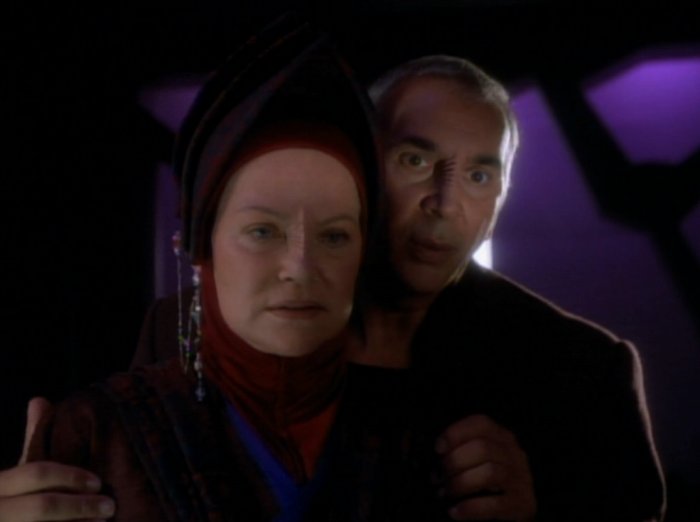
Long story made short, Bareil survives the attempt but Winn and a politician named Jaro conspire to overthrow the Provisional Government through its manipulation of the military and their control of the Circle. What they don't realize is that the arms being supplied to the Circle are actually coming from the Cardassians through an intermediary. The duplicitous Cardassians have an interest in seeing the removal of the Federation so that they can come back and take over a still-weak Bajor. The Feds luckily catch wind of this, but they have orders not to interfere with the coup as it would go against the Prime Directive.
Evidence of the Cardassians' involvement is secreted away by the Bajoran liason officer, Kira Nerys, and in an act of defiance, Commander Benjamin Sisko chooses to interpret his orders loosely and remain aboard the station with his senior staff to stall and impede the Bajoran boarding party long enough for the evidence to reach the PD.
Federation efforts were successful and the coup was stopped in its tracks. But what if Sisko had obeyed his orders to the letter? What if they had allowed the coup to proceed and evacuated the station? Undoubtedly the most important location in the galaxy would have been retaken by the Cardassians and the Bajorans would return to being subjected to occupation and war. Later, as the Dominion War occurs, the Federation would be at an much weaker position and would be more likely to lose, ending an era of freedom, peace, prosperity and multicultural tolerance (not to mention a franchise).
So, realism rules the day in this collection of episodes. The Prime Directive proved inadequate in protecting the Federation and its allies. Only in disobeying it was the Federation able to maintain their strategic hold on the region and later survive the coming war.
A scifi enthusiast analyzes Star Trek: Deep Space Nine for international relations theory.
Showing posts with label Bajor. Show all posts
Sunday, December 9, 2012
Thursday, November 1, 2012
First Season Thoughts: Part 2 (Eminent Domain)
S1:E15 - Progress: Major Kira, the Bajoran liason officer and second in command of DS9 is sent to the Bajoran moon Jeraddo to convince a small group of holdouts to relocate to Bajor to make way for an energy project that will make the moon uninhabitable. As a classic morality play, this episode brings up several ethical questions about social good when it comes in conflict with individual good.
The holdout group is led by a cantankerous, old, Bajoran man named Mullibok. He and his kiln escaped their Cardassian oppressors to live in relative peace and tranquility with a self-maintained subsistence farm on Jeraddo. But the Federation is now helping Bajor with a project that involves tapping the geo-thermal energy of he moon's core to provide power to hundreds of thousands of Bajorans on Bajor. Unfortunately, this process is so disruptive to the crust of the moon, it releases poisonous gasses into the atmosphere. Mullibok is aware of the risks but stubbornly refuses to leave his home, postponing the project indefinitely.
Kira becomes close with Mullibok and sympathizes with him, having clung to irrational hope herself while serving in the resistance. In the end, the ethical questions are never answered and Kira takes the drastic step of burning down his home and beaming him away from the moon's surface.
Spock once famously pronounced the utilitarian ideals of the Federation when he said, "The needs of the many outweigh the needs of the few." While this choice can present itself in clear ways, as when Spock sacrificed his own life to save those of the Enterprise crew, there are still far more ambiguous and problematic issues that arise from that idea. Some of which fly in the face of our modern conception of democracy and freedom. If anything is to be gleaned from the episode, it is perhaps that even centuries later we will be debating eminent domain and New Hampshire farmers will still be blocking Northern Pass well into the 24th Century.
The holdout group is led by a cantankerous, old, Bajoran man named Mullibok. He and his kiln escaped their Cardassian oppressors to live in relative peace and tranquility with a self-maintained subsistence farm on Jeraddo. But the Federation is now helping Bajor with a project that involves tapping the geo-thermal energy of he moon's core to provide power to hundreds of thousands of Bajorans on Bajor. Unfortunately, this process is so disruptive to the crust of the moon, it releases poisonous gasses into the atmosphere. Mullibok is aware of the risks but stubbornly refuses to leave his home, postponing the project indefinitely.
Kira becomes close with Mullibok and sympathizes with him, having clung to irrational hope herself while serving in the resistance. In the end, the ethical questions are never answered and Kira takes the drastic step of burning down his home and beaming him away from the moon's surface.
Spock once famously pronounced the utilitarian ideals of the Federation when he said, "The needs of the many outweigh the needs of the few." While this choice can present itself in clear ways, as when Spock sacrificed his own life to save those of the Enterprise crew, there are still far more ambiguous and problematic issues that arise from that idea. Some of which fly in the face of our modern conception of democracy and freedom. If anything is to be gleaned from the episode, it is perhaps that even centuries later we will be debating eminent domain and New Hampshire farmers will still be blocking Northern Pass well into the 24th Century.
Sunday, October 21, 2012
First Season Thoughts: Part 1
The first season of DS9 focused primarily on the post-occupation aftermath. Bajor is still getting used to being free of the Cardassians and dealing with everything that means. Their political instability is perhaps the most notable issue, followed closely by their tenuous relationship with the Federation. Other issues include religion, commerce, power plays, war criminals and war heroes. Here's a rundown of some notable episodes.S1:E5 - Captive Pursuit: The first alien to from the Gamma Quadrant to emerge from the Bajoran Wormhole appears.
S1:E10 - The Nagus: We are introduced to the Grand Nagus of the Ferengi Alliance and his plans for economic expansion into the Gamma Quadrant. He will be a recurring character in future episodes and his entrepreneurial forays into this unexplored quadrant will hear to the first whispers of an important Gamma Quadrant power. I suppose with those ears, that's no surprise.
S1:E12 - Battle Lines: Kai Opaka is stranded on a prison moon where two groups of prisoners have been waging an eternal war, cursed to immortality. In being killed and reanimated by the biomechanical microbes placed there by the sadistic wardens, and therefore trapped on the moon, Opaka is almost transcended. She sees this all as the "way of the prophets" and her destiny. She feels called upon to teach the warring parties to finally resolve their differences and enjoy peace; a task that will undoubtedly take several years. Thus she becomes an almost mythical legend that ascended to the heavens to work for countless centuries for peace. In some ways, she is like a Christ figure, who quite literally is resurrected and remains living away from her planet. What is the most important thing to note about her departure, however, is that it leaves a significant power vacuum in Bajor that ambitious Vedics will vie for in a cut-throat election to be the next Kai.
Subscribe to:
Posts (Atom)

.jpg)